This website is intended for UK healthcare professionals only.
Adverse event reporting information can be found at the bottom of the page.
LYNPARZA can be taken twice daily, either as a monotherapy or as part of a treatment plan that includes abiraterone and prednisone/prednisolone1
Please see homepage or respective LYNPARZA pages for full indication
Before initiation of LYNPARZA treatment:1
- For LYNPARZA monotherapy treatment in BRCA1/2-mutated mCRPC, patients must have confirmation of a deleterious or suspected deleterious BRCA1/2 mutation before LYNPARZA treatment is initiated
- No genomic testing is required prior to using LYNPARZA in combination with abiraterone and prednisone/prednisolone for the treatment of patients with mCRPC
For further information on patient monitoring requirements before and during LYNPARZA treatment,see below or consult the SmPC.
LYNPARZA monotherapy and combined therapy dosing regimen

Treatment with LYNPARZA should be continued until progression of the underlying disease or unacceptable toxicity when used as monotherapy or when used in combination with abiraterone and prednisone/prednisolone.1
In the case of LYNPARZA monotherapy, LYNPARZA dosing remains the same but without the addition of abiraterone or prednisone/prednisolone.1
In patients who have not been surgically castrated, patients receiving LYNPARZA monotherapy should also receive a luteinising hormone-releasing hormone (LHRH) analogue, and those receiving LYNPARZA plus abiraterone should receive gonadotropin-releasing hormone (GnRH) analogue concurrently.1
Important things to remember when prescribing LYNPARZA1–4

If a patient misses a dose of LYNPARZA, the next dose should be taken at its scheduled time.

Patients should not take more than four LYNPARZA tablets per day. If a patient takes more than four tablets, they should contact you, their HCP, and go to their local hospital emergency department.

All tablets should be swallowed whole; they should not be chewed, crushed, dissolved or divided as this may affect the drug’s absorption into the body.

Grapefruit and grapefruit juice should be avoided whilst a patient is receiving LYNPARZA. For the full list of contraindications, please see the Summary of Product Characteristics.
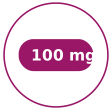
If dose reductions of LYNPARZA are required, tablets are also available in a 100 mg formulation.

If a patient experiences vomiting after taking their dose of LYNPARZA, they should not take a second dose unless the tablets are intact and both can be seen. The next dose should be taken at its scheduled time.

Patients should be instructed to keep a note of any side effects they experience, so they can easily share this information with you at their next appointment.
Use this guide to assist patients with mCRPC who are receiving LYNPARZA
in understanding their therapy
Dose adjustments to manage side effects
When in monotherapy or combination therapy, LYNPARZA treatment may be interrupted to manage adverse reactions, such as nausea, vomiting, diarrhoea and anaemia.1
Dose interruptions

The recommended dose reduction of LYNPARZA is 250 mg twice a day in both monotherapy and combination therapy. If a further dose reduction is required, the second recommended reduction is to 200 mg twice a day.1
Dose reductions

The most common side effects with LYNPARZA can be generally managed with supportive treatment, dose interruptions and dose reductions, limiting the need for patients to discontinue.5,6
Co-administration of LYNPARZA with strong or moderate CYP3A inhibitors is not recommended. If a strong or moderate CYP3A inhibitor must be co-administered, the dose of LYNPARZA should be reduced.1
LYNPARZA co-administration with strong or moderate CYP3A inducers is not recommended. In the event that a patient already receiving LYNPARZA requires treatment with a strong or moderate CYP3A inducer, the prescriber should be aware that the efficacy of LYNPARZA may be substantially reduced.1
It is recommended that the following biochemical markers are monitored for patients receiving LYNPARZA1,3,7

These management strategies were derived from clinical studies or established medical protocol. This information is not meant to replace the clinical judgment of the attending physician. Adverse reactions experienced by patients should be reported to AstraZeneca patient safety.
See details below on reporting adverse events
References
- LYNPARZA (olaparib). Summary of Product Characteristics. November 2023. Available at: https://www.medicines.org.uk/emc/product/9204/smpc Accessed November 2023.
- Clarke N, et al. NEJM Evid. 2022. doi:https://doi.org/10.1056/EVIDoa2200043.
- LYNPARZA (olaparib tablets) Patient Information Leaflet. https://www.medicines.org.uk/emc/product/9204/pil Accessed November 2023.
- Friedlander M, et al. Am Soc Clin Oncol Educ Book 2023;43:e390876.
- Thiery-Vuillemin A, et al. Presented at ASCO Annual Meeting 2022; 3–7 June; Chicago, US; Abstract 5019.
- Roubaud G, et al. Presented at ESMO Virtual Congress 2020; 19–21 September; Poster 624P.
- PROpel Protocol v1.0.
Abbreviations
AE=adverse event; CBC=complete blood count; CrCl=creatinine clearance; CTCAE=Common Terminology Criteria for Adverse Events; GnRH=gonadtropin-releasing hormone; HCP=healthcare professional; LHRH=luteinising hormone-releasing hormone; mCRPC=metastatic castration-resistant prostate cancer; VTE=venous thromboembolism.
February 2025 | Job code: GB-64098